
Use Customer Billing: navigation and daily work
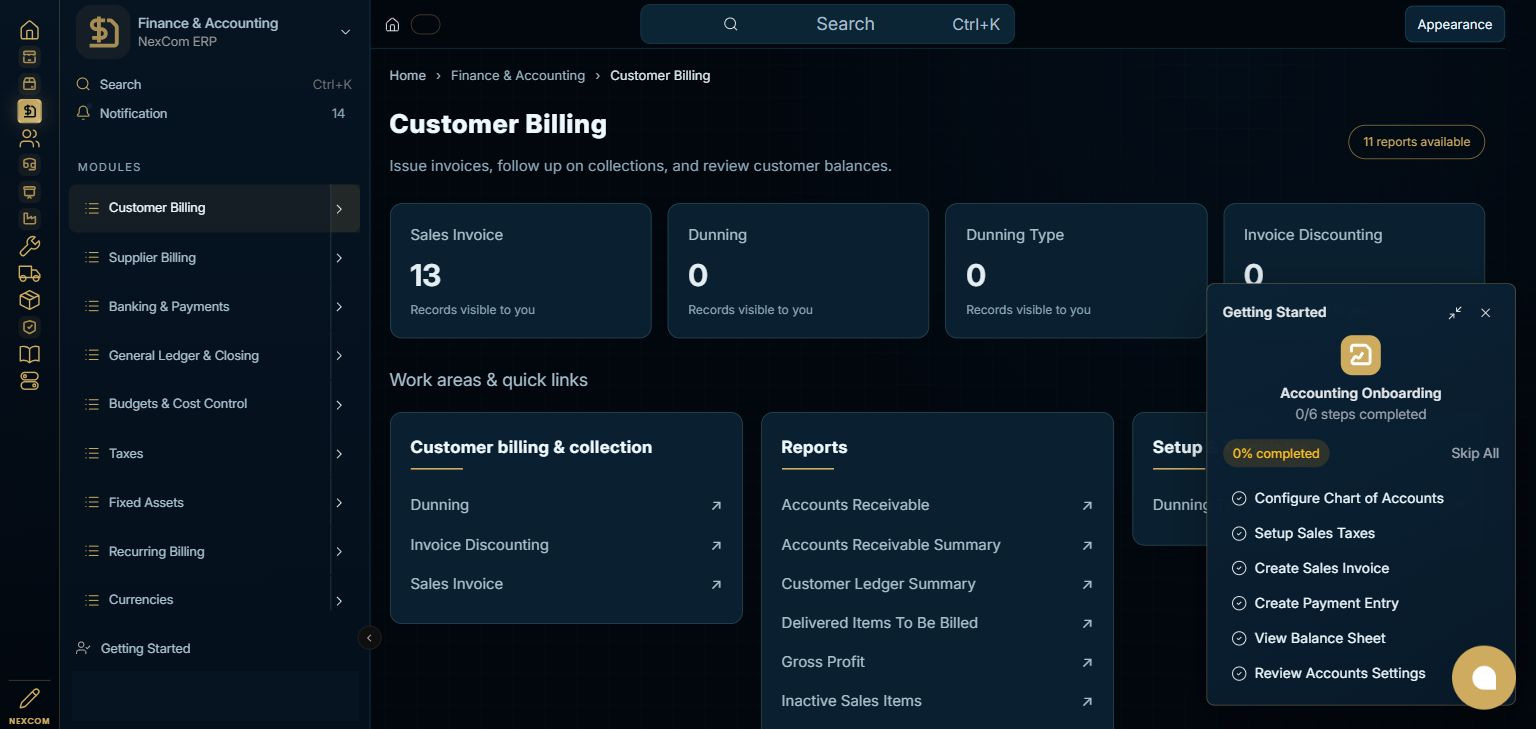
Open Finance & Accounting using the left app rail, then select Customer Billing in its module menu. The module dashboard gathers the available records, reports and setup links.
Before you start
Create sales invoices from the applicable sales or delivery records, review taxes and due dates, and submit after checking. Allocate payments through Payment Entry and inspect the receivable reports for the remaining balance.
Find this module in the ERP
Finance & Accounting → Customer Billing
Step-by-step instructions
Open the module
Open Finance & Accounting using the left app rail, then select Customer Billing in its module menu. The module dashboard gathers the available records, reports and setup links.
{ERP_URL}/desk/nexcom-workflow/Finance%20%26%20Accounting/Customer%20BillingRecord forms may append /{RECORD_ID}; a new draft may use /new-{TYPE}-{TEMP_ID}. Query filters and selected tabs may add a query string or #fragment.
Continue the task
Choose the work area for your task. This staging dashboard provides Sales Invoice, Dunning, Dunning Type, Invoice Discounting. Use an existing record for a change; use Add/New only when a new record is needed and your role permits it.
{ERP_URL}/desk/nexcom-workflow/Finance%20%26%20Accounting/Customer%20BillingRecord forms may append /{RECORD_ID}; a new draft may use /new-{TYPE}-{TEMP_ID}. Query filters and selected tabs may add a query string or #fragment.
Continue the task
Before saving or taking a workflow action, verify the relevant party, company, dates, source links and permissions. Use the field reference linked below for the selected record type. This navigation tutorial does not submit a business transaction.
{ERP_URL}/desk/nexcom-workflow/Finance%20%26%20Accounting/Customer%20BillingRecord forms may append /{RECORD_ID}; a new draft may use /new-{TYPE}-{TEMP_ID}. Query filters and selected tabs may add a query string or #fragment.
Continue the task
For review, open Accounts Receivable, Accounts Receivable Summary, Customer Ledger Summary, Delivered Items To Be Billed, Gross Profit, Inactive Sales Items. Check the report filters, company and date range before interpreting the results. A record count on the dashboard is not a financial total.
{ERP_URL}/desk/nexcom-workflow/Finance%20%26%20Accounting/Customer%20BillingRecord forms may append /{RECORD_ID}; a new draft may use /new-{TYPE}-{TEMP_ID}. Query filters and selected tabs may add a query string or #fragment.
Choose the relevant work area
Check the result
Check the selected record, company, source relationships, field values and available actions. A successful save, approval, submission, external notification and payment are separate events. The module screenshot is a navigation reference; it is not evidence that the business transaction described in this article was executed.
Troubleshooting
Use the installed work areas and the linked task tutorials below. Available actions and records depend on your role; external services may require their own permitted sign-in.